


IPS Communities
Not just an index, an instrument of transformation.
About IPS Communities
IPS Communities is the application of the index methodology in different sub-municipal geographies (communities, neighbourhoods—rural or urban, traditional communities), with the participation of communities in building indicators and collecting data. By adopting an approach focused on detailed analysis of local sensitivities, this methodology enables the construction of an IPS that reflects the specificities of each community. In this way, it becomes possible to obtain a closer and more relevant diagnosis to understand local challenges and needs—facilitating the identification of priority areas for community development.
It represents an important cost-effective in projects by revealing the social and environmental situation of territories, with emphasis on those areas most important as identified by the communities themselves, serving as a guiding instrument or baseline to track the progress of these groups.
IPS Communities is not just a technical document, but an instrument for social transformation. It allows the community to see itself in the data, strengthen collectively, and have greater negotiating power with authorities and partners.
IPS Communities as due diligence social: A tool that offers stakeholders an accurate and reliable assessment of the impact of investments in local communities.
Methodology
IPS Communities, through collective construction, envisages mapping up to six indicators for each of the 12 IPS components:
Human Needs
Nutrition & Medical Care
Water & Sanitation
Housing
Safety
Foundations of Wellbeing
Basic Education
Information & Communications
Health
Environmental Quality
Opportunity
Rights & Voice
Freedom & Choice
Inclusive Society
Advanced Education
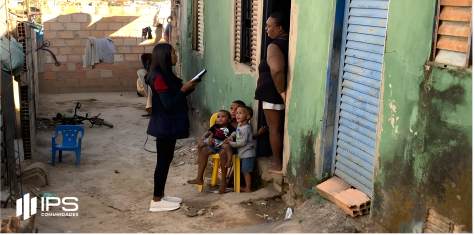
Data collection is carried out on a sample or census basis by local interviewers. At the end of the survey, results are consolidated and returned to the communities, with training on the use of IPS Comunidades.
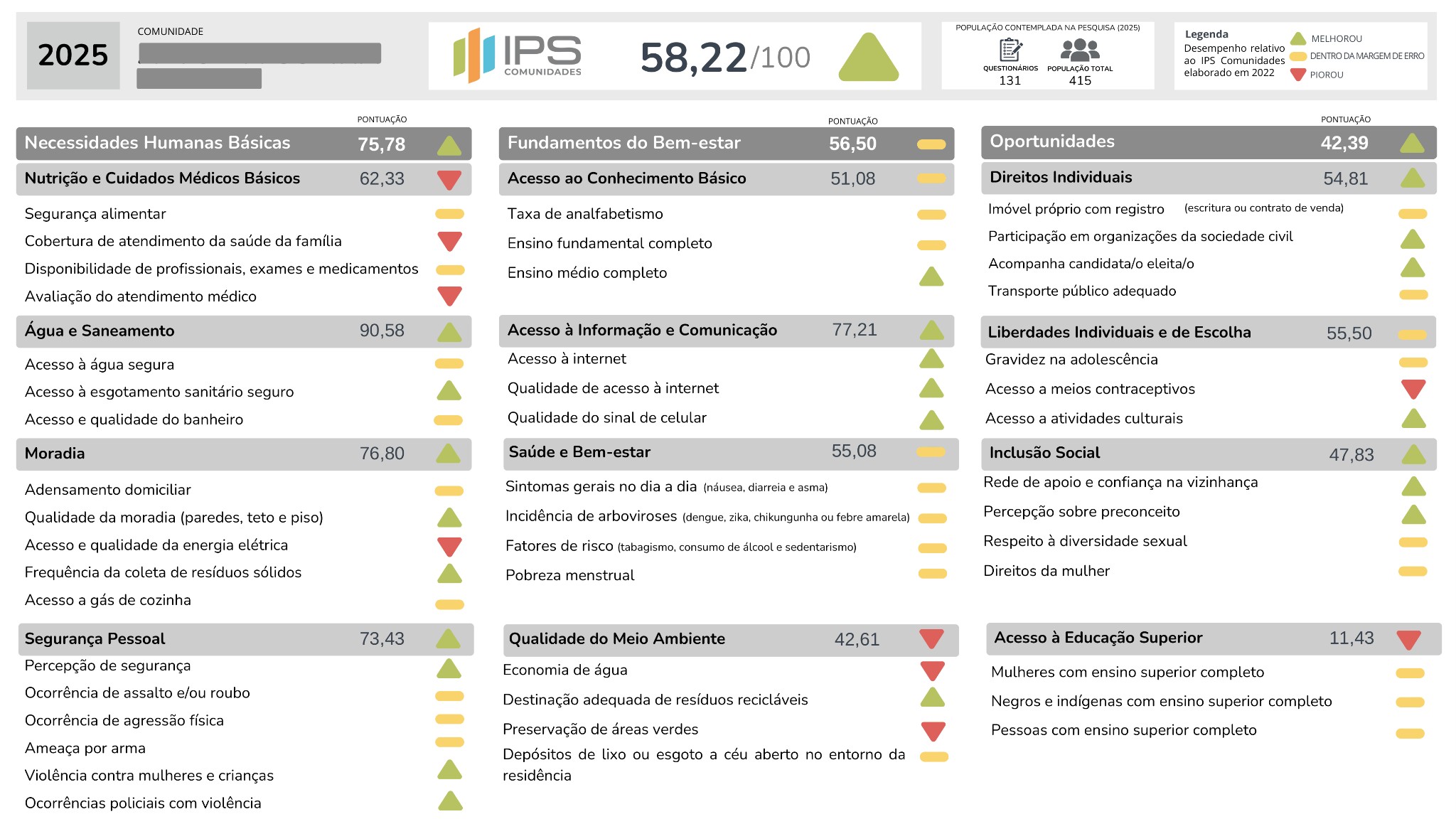
IPS Communities offers a snapshot in time—a portrait of social conditions in a given community. To ensure continuous and accurate assessment of progress, periodic updating of the index every 2 to 4 years is recommended.
Contact us
Contact us to learn more:
Melissa Wilm (melissa.wilm@ipsbrasil.org.br)